Introduction
Motorcycle tyres are among the most important parts of a motorcycle because they provide the contact between the vehicle and the road. They affect grip, stability, braking, cornering, comfort, and overall riding safety.
Choosing the right motorcycle tyres is not only about selecting a popular brand or finding the lowest price. The correct tyres must match the motorcycle’s specifications and the conditions in which it is used. A tyre designed for city commuting may have different characteristics from one intended for touring, off road riding, or high performance use.
Before buying new motorcycle tyres, riders should understand tyre size, construction, tread pattern, load capacity, speed rating, and the type of riding they normally do. This guide explains how to choose motorcycle tyres that suit your bike and riding needs.
1. Check the Recommended Tyre Size
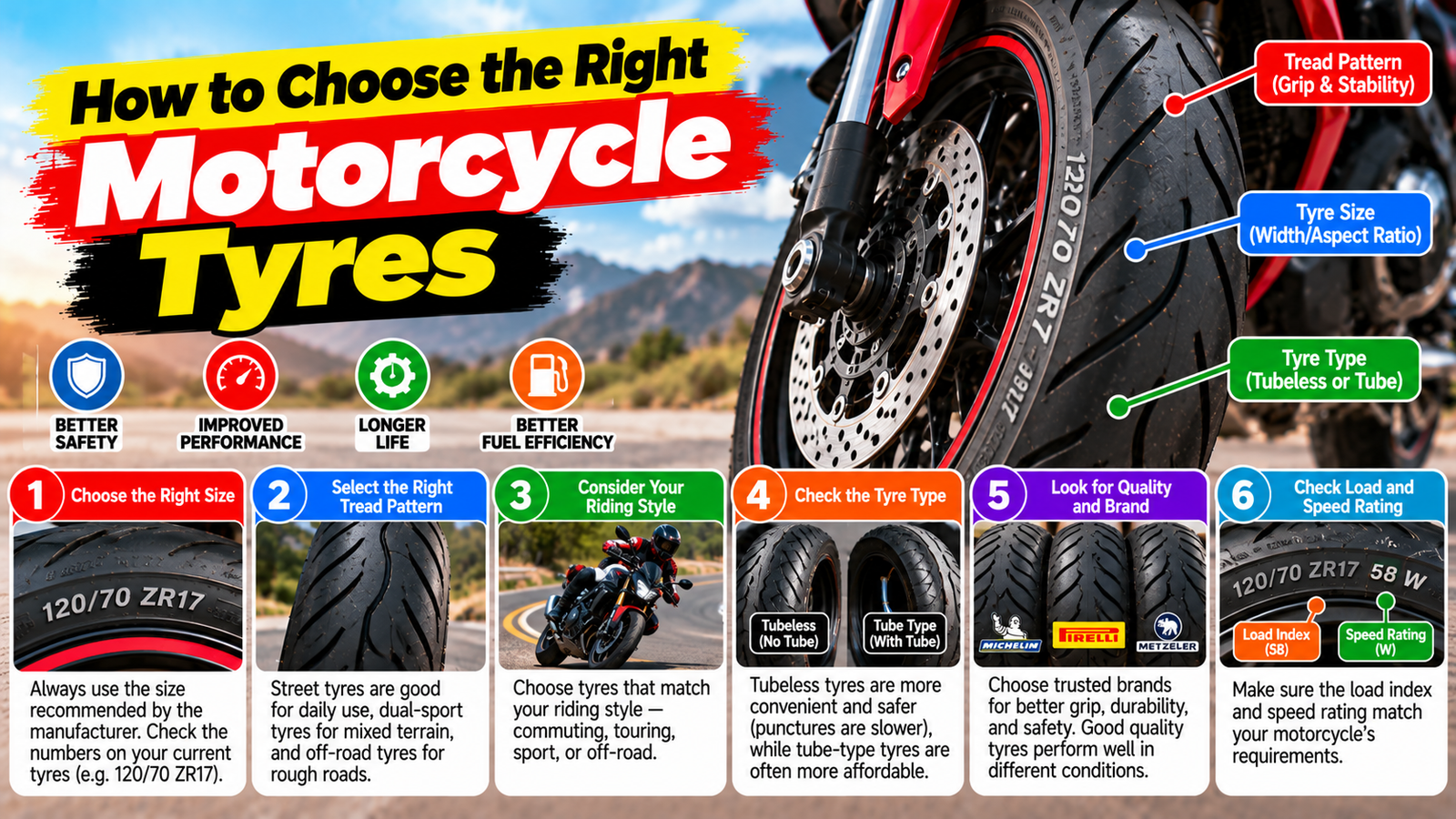
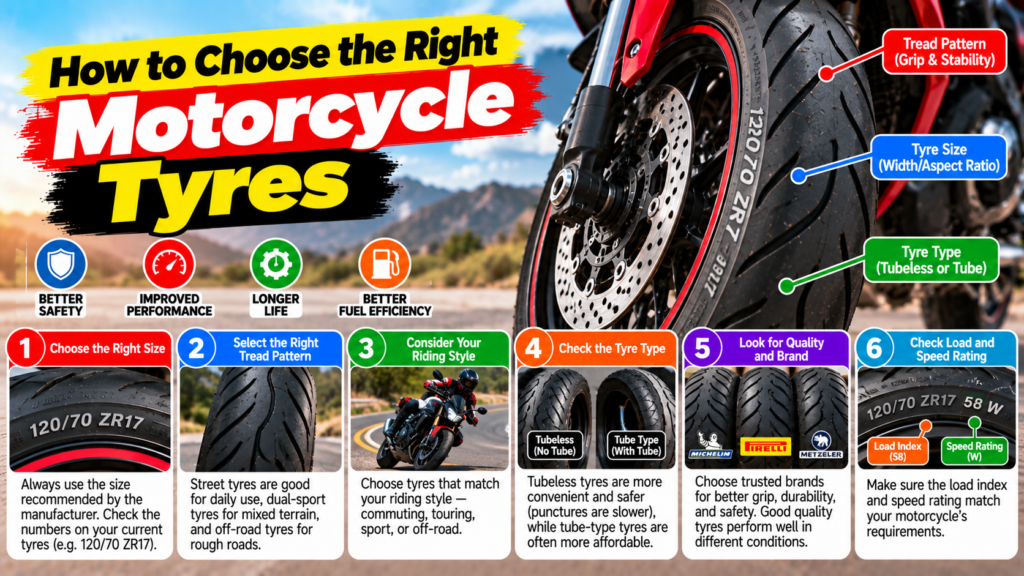
The first step when choosing motorcycle tyres is to check the size recommended by the manufacturer.
Tyre size is usually printed on the sidewall. It may also be listed in the owner’s manual or on a label attached to the motorcycle.
A typical tyre marking might look like 120/70 ZR17, although the exact format depends on the tyre type. In a size such as 120/70 R17, the first number represents the nominal tyre width in millimetres. The second number is the aspect ratio, which expresses the sidewall height as a percentage of the width. The letter R indicates radial construction, and 17 refers to the wheel diameter in inches.
Do not choose a tyre based only on whether it fits physically. Incorrect sizing can affect handling, clearance, speedometer accuracy, and overall performance. Use the size approved for your motorcycle unless a qualified professional confirms that an alternative is suitable.
2. Understand Front and Rear Tyres
Front and rear motorcycle tyres have different responsibilities.
The front tyre plays an important role in steering and contributes significantly to braking stability. The rear tyre transfers engine power to the road and supports acceleration, while also contributing to braking and cornering.
Some tyres are designed specifically for front or rear use. Others may have a directional rotation arrow that must be followed during installation.
Always check the sidewall markings and manufacturer’s instructions. Installing a tyre in the wrong position or rotation direction can affect its intended performance.
3. Choose Tyres Based on Riding Style
The right motorcycle tyres depend on how you normally ride.
For everyday commuting, riders may prefer tyres designed for predictable handling, durability, and performance in common road conditions. Touring tyres are generally developed for longer journeys, stability, comfort, and useful tread life.
Sport tyres focus more on grip and handling during performance riding, while off road tyres use tread patterns suited to loose surfaces such as dirt and gravel. Adventure tyres may balance road performance with some off road capability.
No single tyre is ideal for every situation. Choose a design that matches your actual riding needs rather than buying tyres intended for conditions you rarely encounter.
4. Consider the Road Conditions
Think about the roads you use most often.
If you mainly ride on paved city roads, a road oriented tyre may be the most practical choice. If your regular routes include rough surfaces or unpaved roads, you may need a tyre designed for those conditions.
Rain is another important consideration. Tyre design, rubber compound, tread depth, and water drainage can all influence wet road performance.
However, no tyre can eliminate the risk of slipping on wet roads, oil, loose gravel, or painted road markings. Reduce speed in poor conditions and avoid sudden braking or sharp steering movements.
5. Understand Tread Patterns
The tread pattern is the design of grooves and channels on the tyre surface.
On road tyres, tread grooves help manage water and support performance in wet conditions. The exact pattern varies according to the intended use and tyre design.
Off road tyres often have larger blocks and spaces that help them work on loose surfaces. Some adventure tyres use a more balanced pattern to support both paved roads and light off road travel.
Tread appearance alone does not prove that one tyre is better than another. The rubber compound, construction, tyre profile, and intended application are also important.
Choose a tyre designed for the surfaces you ride on most frequently.
6. Check Load Capacity and Speed Rating
Motorcycle tyres are designed to carry a specific load and operate within a specified speed category.
The load index indicates the tyre’s rated carrying capacity under the conditions defined by the manufacturer. The speed rating indicates the maximum speed category for which the tyre is approved under specified test conditions.
Both markings must be suitable for the motorcycle and its intended use. The required ratings can usually be found in the owner’s manual or manufacturer specifications.
Do not assume that a tyre is suitable simply because its dimensions match the original tyre. A tyre with an unsuitable load index or speed rating may not meet the motorcycle’s requirements.
7. Compare Tyre Construction
Motorcycle tyres are available in different construction types, including bias ply and radial designs.
Bias ply tyres use layers arranged diagonally across the tyre. Radial tyres have a different carcass structure, with the main body cords arranged more directly across the tyre and additional belt construction depending on the design.
These construction methods affect flexibility, heat management, handling, and the way a tyre responds to loads. The benefits depend on the specific tyre and motorcycle.
Not every motorcycle can use every construction type. Follow the manufacturer’s approved specifications and avoid mixing incompatible tyre designs.
8. Select the Correct Rubber Compound
The rubber compound affects grip, wear, and performance across different temperatures.
Some tyres use compounds designed to support long service life and everyday riding. Others prioritize grip for sport riding. Certain modern designs use different compounds across sections of the tyre to balance cornering grip and durability.
A tyre that offers high grip may wear more quickly under some conditions, while a long life tyre may be better suited to routine commuting. Actual performance varies by model and riding style.
Consider how often you ride, the types of roads you use, and whether durability or specialized performance is more important for your needs.
9. Check Tyre Manufacturing Date and Condition
Before buying tyres, inspect their condition and manufacturing information.
Many tyres carry a date code as part of the identification marking. The exact format depends on the tyre standard, but modern date codes commonly identify the week and year of manufacture.
A tyre’s age is only one factor in determining its suitability. Storage conditions, exposure to sunlight, heat, chemicals, and the manufacturer’s recommendations also matter.
Avoid tyres with visible cracks, bulges, damaged beads, or signs of improper storage. Buy from a reputable seller who can provide appropriate storage and product information.
If you are unsure about the age or condition of a tyre, ask the manufacturer or a qualified tyre professional for advice.
10. Consider Tubed and Tubeless Tyres
Motorcycle tyres may be designed for use with an inner tube or as a tubeless system.
Tubed tyres use an inner tube to hold the air. Tubeless tyres seal against a compatible rim and hold air without a separate tube under normal operation.
The wheel design is important. A tyre marked for tubeless use should not automatically be assumed suitable for every rim, and some wheel designs require a tube even when the tyre construction allows tubeless use.
Check the motorcycle’s wheel and tyre specifications before purchasing replacements. Incorrect combinations can create air loss or other safety problems.
11. Choose a Reliable Brand and Seller
Brand reputation can help when comparing tyres, but it should not be the only deciding factor.
Look for a tyre that meets the motorcycle’s specifications, suits your riding conditions, and comes from a reliable seller. Check the product model rather than comparing brands only by name.
Ask about warranty coverage, storage practices, installation, and whether the tyre is intended for your motorcycle. Avoid suspiciously cheap products that may be old, counterfeit, damaged, or unsuitable.
A suitable tyre from a reputable source is generally a better choice than a product selected only because it has the lowest price.
12. Understand Tyre Pressure and Maintenance
Buying the right motorcycle tyres is only the beginning. Correct pressure and regular maintenance are also essential.
Use the tyre pressure recommended by the motorcycle manufacturer, checking it when the tyres are cold unless the manual specifies otherwise. Do not automatically use the maximum pressure printed on the tyre sidewall as the normal riding pressure.
Inspect tyres for cuts, punctures, bulges, uneven wear, and embedded objects. Check tread depth against the applicable legal requirements and the manufacturer’s guidance.
Incorrect pressure can affect handling, tyre temperature, wear, and stability. Check pressure regularly, especially before long journeys or when carrying a passenger or luggage.
13. Replace Tyres at the Right Time
Tyres should be replaced when they reach the applicable tread wear limit or show damage that makes them unsafe.
Other warning signs include cracks, bulges, repeated pressure loss, exposed cords, or significant uneven wear. Tyres may also need replacement because of age, even if tread remains, depending on their condition and the manufacturer’s guidance.
Do not wait for a tyre to become completely bald before replacing it. Worn tread can reduce performance, especially in wet conditions.
If a tyre has suffered a puncture, ask a qualified tyre professional whether it can be repaired safely. Not every puncture or location is repairable.
Conclusion
Choosing the right motorcycle tyres involves more than selecting a size or brand. Riders should check the approved tyre dimensions, load and speed ratings, construction, tread design, and compatibility with the motorcycle’s wheels.
Consider the roads you use, your riding style, and the conditions you commonly face. Buy tyres from a reliable seller and maintain the correct pressure after installation.
Suitable tyres, regular inspections, and responsible riding habits help improve grip, stability, and confidence on the road. When in doubt, consult the motorcycle manufacturer’s recommendations or a qualified tyre professional before making a purchase.