Introduction
A motorcycle engine is one of the most important components of a motorcycle because it produces the power needed to move the bike. Whether someone rides a small commuter motorcycle or a powerful sports bike, the engine performs the same basic job of converting energy into mechanical movement.
Understanding how a motorcycle engine works can help riders learn more about their bikes, identify common engine problems, and make better maintenance decisions. In my opinion, every motorcycle owner should have a basic understanding of the engine, even if they do not have experience repairing mechanical parts.
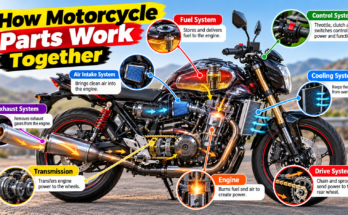
A motorcycle engine contains several components that work together during every ride. These include the cylinder, piston, crankshaft, valves, spark plug, fuel system, and lubrication system. Each component has a specific function, and a problem with one part can affect the performance of the entire engine.
In this article, I will explain how a motorcycle engine works, its main components, the combustion process, and the maintenance practices that help keep it running properly.
What Is a Motorcycle Engine?
A motorcycle engine is a mechanical system that converts the energy stored in fuel into movement. Most traditional motorcycles use petrol engines that operate through internal combustion.
In an internal combustion engine, fuel burns inside the engine’s combustion chamber. The pressure produced by combustion pushes the piston, creating movement that is transferred through the crankshaft and transmission to the driven wheel.
Motorcycle engines are available in different sizes and designs. Engine size is usually measured in cubic centimeters, known as CC. For example, a 100cc motorcycle has a smaller engine displacement than a 150cc motorcycle.
Engine size alone does not determine the complete performance of a motorcycle. Engine design, tuning, weight, transmission ratios, and other factors also influence acceleration, fuel consumption, and maximum power.
1. Main Components of a Motorcycle Engine
To understand how a motorcycle engine works, it is useful to become familiar with its main components.
Cylinder
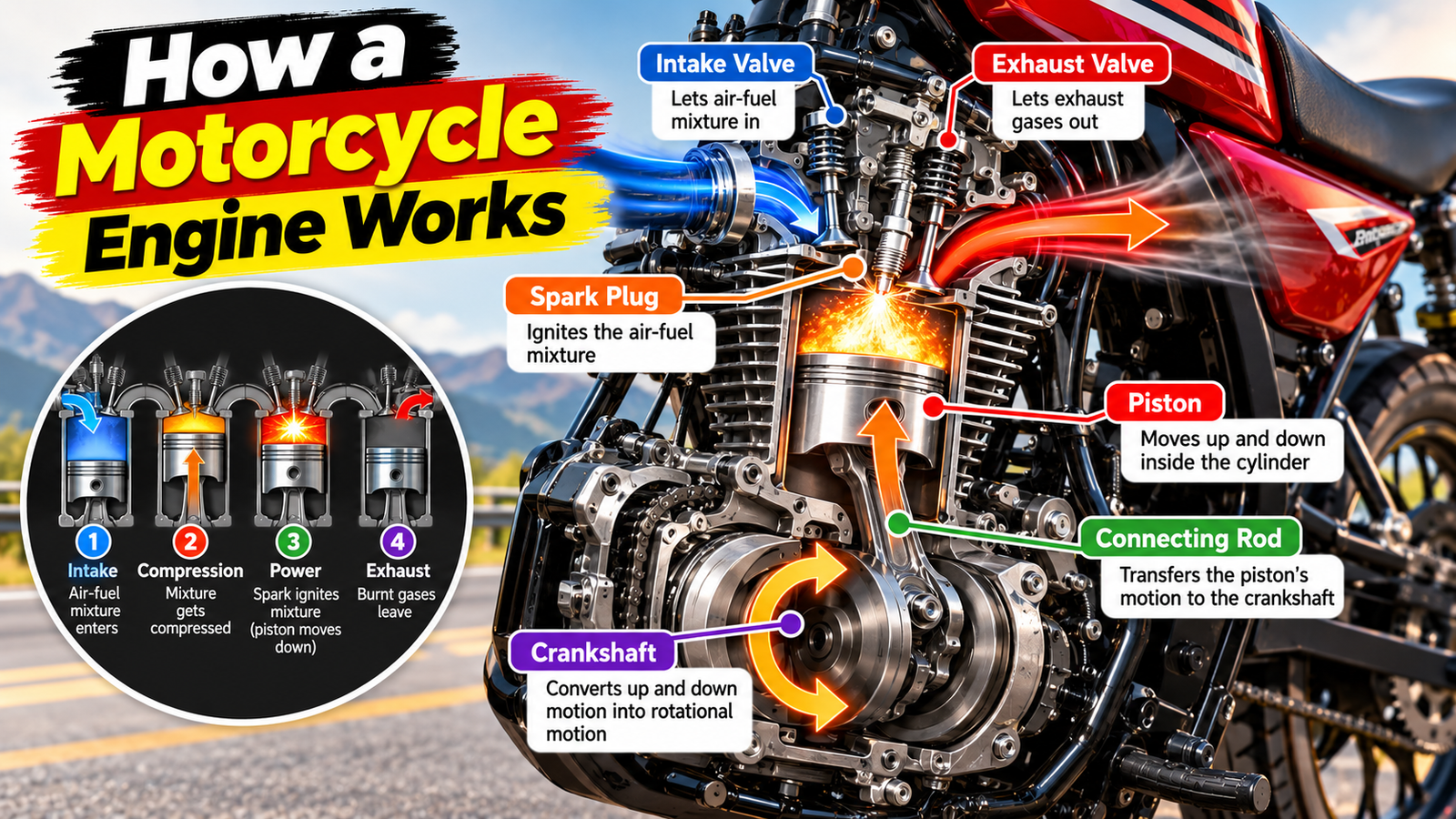
The cylinder is the space in which the piston moves up and down. It provides the working area where the air and fuel mixture is compressed and combustion takes place.
The cylinder must withstand high temperatures and pressure during engine operation. Its design and condition affect engine efficiency and performance.
Piston
The piston moves inside the cylinder. During the engine cycle, it moves downward as combustion produces pressure and moves upward during compression and exhaust.
The piston transfers force to the connecting rod, which then transfers movement to the crankshaft.
Connecting Rod
The connecting rod connects the piston to the crankshaft. It transfers the piston’s movement and helps convert the piston’s up and down motion into the rotational movement needed to drive the motorcycle.
Crankshaft
The crankshaft converts the piston’s reciprocating movement into rotational movement. This rotation eventually reaches the transmission and the rear wheel through the motorcycle’s drive system.
Valves
In many four stroke motorcycle engines, intake and exhaust valves control the movement of gases into and out of the cylinder.
The intake valve allows the air and fuel mixture, or air alone in fuel injected designs, to enter the cylinder. The exhaust valve allows burned gases to leave.
Spark Plug
The spark plug produces an electrical spark that ignites the compressed air and fuel mixture in a petrol engine. Its condition can affect starting, smooth operation, and combustion efficiency.
These components work together continuously while the engine is running.

2. How a Four Stroke Motorcycle Engine Works
Many motorcycles use four stroke engines. These engines complete one operating cycle through four piston strokes: intake, compression, power, and exhaust.
Each stroke has a different purpose.
Intake Stroke
During the intake stroke, the piston moves downward inside the cylinder while the intake valve opens.
This movement draws air and fuel into the cylinder in a carbureted engine. In many fuel injected engines, air enters the cylinder and fuel is delivered separately through an injector.
The amount of air and fuel supplied depends on the engine design and operating conditions.
Compression Stroke
During the compression stroke, the piston moves upward while the valves remain closed.
This compresses the mixture inside the cylinder, preparing it for combustion. Compression helps the engine produce useful power from the burning fuel.
The compression ratio is an important engine specification because it influences efficiency, power characteristics, and fuel requirements.
Power Stroke
During the power stroke, the spark plug ignites the compressed air and fuel mixture.
Combustion creates high pressure inside the cylinder, forcing the piston downward. The connecting rod transfers this force to the crankshaft, which rotates and produces mechanical power.
This is the main stroke that supplies useful power to the engine.
Exhaust Stroke
During the exhaust stroke, the piston moves upward while the exhaust valve opens.
The piston pushes burned gases out of the cylinder and into the exhaust system. The cylinder is then ready to begin another intake stroke.
This four stroke cycle repeats continuously while the engine operates.
3. How a Two Stroke Motorcycle Engine Works
Some motorcycles, particularly certain older models and specialized off road bikes, use two stroke engines.
A two stroke engine completes its basic operating cycle in two piston strokes, or one crankshaft revolution. Intake, compression, combustion, and exhaust processes are arranged differently from those in a four stroke engine.
Two stroke engines can have a relatively simple design and a high power output for their size. However, traditional two stroke engines generally produce more exhaust emissions than comparable modern four stroke engines.
Lubrication methods also differ. Many traditional two stroke engines require oil to be mixed with fuel or supplied through a separate oil injection system. Riders should follow the exact requirements of their engine.
Four stroke and two stroke engines should not be maintained in exactly the same way because their internal designs and lubrication systems are different.
4. How Fuel Reaches the Engine
A motorcycle engine needs the correct amount of fuel to operate properly.
In motorcycles with carburetors, the carburetor mixes fuel with incoming air before the mixture enters the engine. The design uses airflow and fuel passages to deliver a suitable mixture under different operating conditions.
Many modern motorcycles use electronic fuel injection. This system uses injectors and electronic controls to manage fuel delivery.
Depending on the motorcycle, sensors can monitor factors such as engine temperature, throttle position, and the amount of incoming air. The electronic control unit uses this information to adjust fuel delivery.
A properly maintained fuel system helps support reliable starting, smooth acceleration, and efficient engine operation.
Problems with clogged injectors, a dirty carburetor, a blocked fuel filter, or poor fuel delivery can cause starting difficulties and uneven performance.
5. The Role of the Air Filter
Fuel alone cannot operate a conventional petrol engine. The engine also needs oxygen from the air to support combustion.
The air filter prevents dust, dirt, and other particles from entering the engine. This is particularly important for motorcycles that travel on dusty roads.
When the air filter becomes clogged, it can restrict airflow and affect engine performance. The exact effect depends on the engine and fuel system.
Cleaning or replacing the air filter according to the manufacturer’s instructions can help maintain proper airflow and protect internal engine components.
Riders should avoid operating the motorcycle without the required air filter because dust entering the engine can contribute to premature wear.
6. How the Transmission Transfers Engine Power
Producing power is only part of the process. The motorcycle must also transfer that power to the rear wheel.
The crankshaft supplies rotational power to the transmission through the engine’s drivetrain arrangement. The clutch allows the rider to connect or disconnect engine power, while the gearbox provides different gear ratios.
When the rider selects a suitable gear and releases the clutch, engine power moves through the transmission.
On a chain driven motorcycle, the gearbox output turns the front sprocket. The chain transfers this movement to the rear sprocket, causing the rear wheel to rotate.
Belt driven and shaft driven motorcycles use different final drive arrangements, but their purpose is similar.
7. Why Engine Oil Is Important
Engine oil is essential for reducing friction between moving parts. Without suitable lubrication, metal components can wear quickly because they operate under pressure and at high temperatures.
Engine oil helps lubricate components such as the crankshaft, piston assembly, and other internal parts. Depending on the engine design, it may also help cool components and carry small contaminants toward the oil filter or other filtration system.
Many four stroke motorcycles use engine oil that also lubricates the gearbox and wet clutch. Other motorcycles have different lubrication arrangements.
Riders should use the oil grade and specification recommended by the manufacturer. They should also check the oil level and follow the recommended oil and filter replacement intervals.
Using unsuitable oil or operating with insufficient oil can cause serious engine damage.
8. How a Motorcycle Engine Stays Cool
During combustion, the engine produces a significant amount of heat. If this heat is not managed properly, the engine can become excessively hot and suffer damage.
Motorcycles generally use air cooling or liquid cooling.
Air cooled engines release heat through external cooling fins and airflow around the engine. This design is relatively simple and is common on many commuter motorcycles.
Liquid cooled engines circulate coolant through passages in the engine. The heated coolant moves to a radiator, where airflow helps release the heat.
Some liquid cooled motorcycles use an electric fan to support cooling when airflow is limited.
Riders should monitor signs of overheating and follow the correct maintenance procedure for their motorcycle’s cooling system. A hot pressurized radiator should never be opened because escaping coolant can cause severe burns.
9. Common Motorcycle Engine Problems
Motorcycle engines can develop problems because of wear, poor maintenance, fuel system issues, or electrical faults.
Some common symptoms include the following.
Difficulty starting: This may result from a weak battery, faulty spark plug, fuel delivery problem, or another ignition or engine issue.
Loss of power: A blocked air filter, fuel system problem, worn engine components, or incorrect adjustment may affect performance.
Unusual engine noise: Knocking, rattling, or other new noises can indicate a mechanical problem that needs investigation.
Overheating: Cooling system faults, low coolant where applicable, insufficient lubrication, or unsuitable operating conditions can contribute to excessive engine temperature.
Excessive exhaust smoke: Smoke may be related to oil consumption, an overly rich fuel mixture, or other engine problems. The meaning depends on the smoke’s colour and the engine design.
These symptoms do not always have a single cause. If a problem continues or becomes severe, it is best to have the motorcycle checked by a qualified mechanic.
10. How to Maintain a Motorcycle Engine
Regular maintenance can help keep a motorcycle engine reliable and reduce avoidable repair expenses.
Here are some useful practices:
- Check engine oil regularly and replace it according to the service schedule.
- Clean or replace the air filter as recommended.
- Use the correct fuel and engine oil specifications.
- Inspect the spark plug at the recommended intervals.
- Keep the cooling system in good condition.
- Maintain the fuel system according to the manufacturer’s instructions.
- Avoid repeatedly revving a cold engine unnecessarily.
- Pay attention to unusual noises, smoke, leaks, or changes in performance.
- Follow the owner’s manual for servicing and inspections.
- Have serious engine problems inspected before they become worse.
Maintenance requirements differ between motorcycle models, so the owner’s manual should always be the main reference.
Conclusion
A motorcycle engine works by converting fuel energy into mechanical power through a series of carefully coordinated processes. The piston moves inside the cylinder, the connecting rod transfers force to the crankshaft, and the transmission carries power toward the rear wheel.
The fuel system supplies the necessary fuel, the air filter protects the engine, the spark plug ignites the mixture, and the lubrication and cooling systems help protect internal components.
In my opinion, learning how a motorcycle engine works is useful for every rider because it makes maintenance less confusing and helps explain common mechanical problems. Although riders do not need to understand every internal detail, knowing the basic operating principles can help them make better decisions about servicing and repairs.
With regular maintenance, responsible riding, and attention to early warning signs, a motorcycle engine can provide dependable performance for a long time.