Introduction
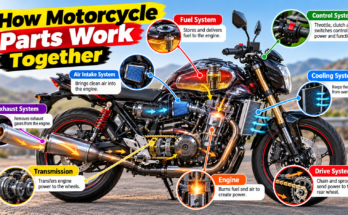
Learning the basic motorcycle parts names is a good starting point for anyone who owns a motorcycle or wants to understand how bikes work. A motorcycle contains many components, and each part has a specific function. Some parts help the motorcycle move, while others control speed, provide stability, improve comfort, or support safety.
In my opinion, beginners do not need to learn every technical detail at once. It is more useful to start with the main motorcycle parts, understand their functions, and gradually learn how they work together. This knowledge can help when purchasing spare parts, discussing repairs with a mechanic, or performing simple maintenance at home.
Motorcycles come in different designs, but most share several important components. These include the engine, fuel tank, clutch, gearbox, wheels, tires, brakes, handlebar, battery, and suspension system.
In this article, I will explain the basic motorcycle parts names for beginners in simple language, including their functions and importance in everyday riding.
1. Engine
The engine is the main component that produces power for the motorcycle. Most traditional motorcycles use petrol engines that convert fuel energy into mechanical movement.
The engine contains several internal parts, including pistons, cylinders, valves, and a crankshaft. These components work together to produce the power required to move the bike.
Motorcycle engines come in different sizes, commonly measured in cubic centimeters, or CC. Smaller engines are often found in commuter motorcycles, while larger engines are used in motorcycles designed for greater power and performance.
For beginners, the most important thing to remember is that the engine needs suitable fuel, lubrication, airflow, and maintenance to operate correctly.
2. Fuel Tank
The fuel tank stores petrol for the engine. It is usually located above the engine, making it convenient for the rider to refuel the motorcycle.
Fuel tank capacity affects how much petrol the motorcycle can carry, but it does not determine fuel economy by itself.
The distance a motorcycle travels on a full tank depends on its engine size, fuel consumption, riding habits, traffic, and road conditions.
Riders should use the fuel recommended by the manufacturer and check for leaks or damage around the tank and fuel lines.
3. Handlebar
The handlebar is the main steering component of a motorcycle. It allows the rider to control the direction of the front wheel.
The handlebar also holds several controls, including the throttle, brake lever, clutch lever on manual motorcycles, switches, and sometimes mirrors or other accessories.
A comfortable handlebar position can make riding easier, especially during daily commuting.
Beginners should learn how to hold the handlebar properly and operate its controls without making sudden movements. Loose fittings or unusual resistance during steering should be checked before riding.
4. Throttle
The throttle controls the engine’s power output. It is usually located on the right handlebar and operated by twisting the handgrip.
When the rider opens the throttle, the engine responds by producing more power according to the fuel and air supplied by its system. Closing the throttle reduces the power being produced.
Smooth throttle control is important when starting, accelerating, turning, and riding through traffic.
The throttle should move freely and return to its closed position when released. If it sticks or does not return correctly, the motorcycle should be inspected before further use.
5. Clutch Lever
The clutch lever is usually located on the left handlebar of a manual motorcycle.
It allows the rider to disconnect engine power from the transmission temporarily. This makes it possible to change gears and start moving smoothly from a stationary position.
The clutch requires coordination between the rider’s hand and the throttle. Releasing it gradually while applying suitable throttle helps prevent the engine from stalling when starting.
Not every motorcycle has a conventional manual clutch lever. Automatic and some semi automatic motorcycles use different transmission arrangements.
6. Gear Shift Pedal
The gear shift pedal allows the rider to change gears. On many manual motorcycles, it is positioned near the rider’s left foot.
The gearbox provides different gear ratios for different speeds and riding conditions.
Lower gears are generally used when starting or travelling at low speeds. Higher gears are suitable for faster travel when road conditions and engine speed allow.
Beginners should become familiar with their motorcycle’s gear pattern by checking the owner’s manual. They should practise gear changes in a safe, suitable environment rather than learning in heavy traffic.
7. Front and Rear Brakes
The braking system helps the rider slow down and stop the motorcycle.
Most motorcycles have front and rear brakes. Depending on the design, these may be disc brakes, drum brakes, or a combination of both.
Disc brakes use pads that press against a rotating disc. Drum brakes use brake shoes that press against the inside of a drum.
Both brakes are important, and riders should learn how their motorcycle responds to controlled braking.
The front brake usually provides a substantial share of the stopping force during firm braking. Beginners should practise smooth, progressive braking and avoid sudden inputs that could cause a loss of control.
Brake components must be maintained properly because worn or damaged brakes can create serious safety risks.

8. Wheels
A motorcycle usually has two wheels that support the bike and allow it to move.
The front wheel follows steering input, while the rear wheel commonly receives power from the engine through the drivetrain.
Wheels may use cast alloy rims or spoked designs, depending on the motorcycle.
Damaged rims, loose spokes, worn bearings, or alignment problems can affect stability and handling. Riders should check for visible damage and unusual movement during maintenance inspections.
9. Tires
Tires provide contact between the motorcycle and the road. They are essential for grip, steering, acceleration, and braking.
Different motorcycles use different tire designs depending on their intended use. Road tires, touring tires, and off road tires are designed for different riding conditions.
Tire pressure is especially important. Incorrect pressure can affect handling, comfort, tire wear, and braking performance.
Beginners should learn the recommended tire pressure for their motorcycle and check it regularly with a suitable pressure gauge.
They should also inspect the tread, sidewalls, and overall condition of both tires.
10. Front Suspension
The front suspension absorbs bumps and helps the front wheel maintain contact with the road.
Most motorcycles use telescopic front forks, although other designs are available.
When the motorcycle passes over an uneven surface, the suspension moves to reduce the impact transferred to the frame and rider.
A properly maintained front suspension contributes to comfort and steering stability.
Signs of possible problems include oil leakage, excessive bouncing, or unusual handling. These issues should be inspected by a qualified mechanic.
11. Rear Shock Absorber
The rear shock absorber helps control the movement of the rear suspension.
Most motorcycles use one or two rear shock absorbers, depending on the design. These components help absorb road impacts and maintain stability when riding over uneven surfaces.
The rear suspension also supports the motorcycle when carrying a passenger or luggage, within the manufacturer’s load limits.
A worn shock absorber may cause excessive bouncing or make the motorcycle feel less stable.
Regular inspection helps identify leaks, damage, or other signs of wear.
12. Chain and Sprockets
Many motorcycles use a chain drive to transfer power from the gearbox to the rear wheel.
The front sprocket receives power from the transmission, and the chain transfers it to the rear sprocket. The rear sprocket then turns the wheel.
The chain must have the correct tension and lubrication to operate properly.
A loose, dry, or excessively worn chain can create noise and affect power delivery. Riders should follow the manufacturer’s instructions for cleaning, lubrication, tension adjustment, and replacement.
Some motorcycles use belt or shaft drives instead of chains.
13. Battery
The battery supplies electrical energy for starting and operating many motorcycle systems.
Depending on the motorcycle, it powers the electric starter, lights, horn, dashboard, and other electrical components.
A weak battery can cause slow starting, dim lights, or electrical problems.
Beginners should learn where the battery is located and how to recognize signs of a problem. Battery maintenance should follow the instructions for its specific type.
If the battery repeatedly loses charge, the issue may involve the battery itself or the motorcycle’s charging system.
14. Headlight
The headlight illuminates the road ahead and helps other road users see the motorcycle.
It is particularly important during night riding and periods of poor visibility.
Motorcycles may use halogen, LED, or other lighting technologies.
Beginners should check that the headlight operates properly before riding in low light conditions. A damaged light or faulty electrical connection should be repaired promptly.
15. Tail Light and Indicators
The tail light makes the motorcycle visible to road users approaching from behind.
The brake light becomes brighter when the rider applies the brakes, warning following traffic that the motorcycle is slowing down.
Turn indicators communicate the rider’s intention to turn or change direction.
These lights are important in busy traffic because other drivers need to understand what the motorcycle is about to do.
Riders should check the indicators, tail light, and brake light regularly.
16. Mirrors
Motorcycle mirrors help the rider observe traffic behind and beside the bike.
Correctly adjusted mirrors can make it easier to monitor vehicles approaching from the rear and identify suitable gaps in traffic.
Mirrors do not eliminate blind spots, so riders should also use appropriate head checks when changing lanes or turning, where safe and necessary.
Loose, cracked, or poorly adjusted mirrors should be corrected before riding.
17. Exhaust Pipe and Muffler
The exhaust system carries combustion gases away from the engine.
The exhaust pipe directs gases through the system, while the muffler reduces exhaust noise. Some motorcycles also contain a catalytic converter to help reduce harmful emissions.
A damaged exhaust system may produce unusual noise, leak gases, or affect performance.
Riders should avoid touching the exhaust while it is hot because it can cause serious burns.
Any exhaust leak or loose fitting should be inspected and repaired appropriately.
18. Air Filter
The air filter prevents dust and other particles from entering the engine.
Clean air is necessary for proper combustion, and the filter helps protect internal engine components from contamination.
A dirty or clogged filter may restrict airflow and affect performance.
The cleaning or replacement interval depends on the motorcycle’s design and the conditions in which it is ridden.
Beginners should check the owner’s manual to understand how the filter is inspected and maintained.
19. Spark Plug
The spark plug produces the spark that ignites the compressed fuel and air mixture in a petrol engine.
A properly functioning spark plug supports reliable starting and smooth engine operation.
A worn or damaged spark plug can contribute to misfiring, difficult starting, and poor performance.
Spark plugs should be inspected and replaced according to the manufacturer’s recommendations. The correct type and specification are important because not every spark plug suits every engine.
20. Frame
The frame is the main structural foundation of the motorcycle.
It supports the engine, fuel tank, suspension, seat, and other major components. Its design contributes to the bike’s strength, stability, and handling.
A damaged or bent frame can affect how safely a motorcycle operates.
After a serious collision or fall that may have caused structural damage, the motorcycle should be inspected by a qualified professional.
21. Seat and Footrests
The seat provides support for the rider and, on many motorcycles, a passenger.
Its shape and padding influence comfort during daily commuting and longer journeys.
Footrests provide a place for the rider to position their feet. Passenger footrests allow a passenger to sit more securely.
Loose footrests, damaged mounting points, or an unstable seat should be repaired before use.
22. Side Stand
The side stand supports the motorcycle while it is parked.
It folds down to one side and is commonly used during short stops and everyday parking.
Some motorcycles also have a center stand that holds the bike in a more upright position.
Beginners should always make sure the side stand is fully retracted before moving away. Some motorcycles include a safety switch that helps prevent riding with the stand down under certain conditions.
Tips for Beginners Learning Motorcycle Parts Names
Learning motorcycle parts becomes easier when you connect each name with its location and purpose.
Here are some practical tips:
- Read the owner’s manual and identify the parts described in it.
- Look at your motorcycle while it is parked safely with the engine switched off.
- Learn the location of the engine, fuel tank, brakes, chain, battery, and suspension.
- Practise identifying the handlebar controls before riding.
- Ask a qualified mechanic to explain unfamiliar components during routine servicing.
- Keep a list of common replacement parts and their correct names.
- Never remove safety critical components without suitable knowledge and tools.
Understanding the names is only the first step. Proper maintenance and safe riding habits are equally important.
Conclusion
Learning basic motorcycle parts names for beginners is a practical way to understand how a motorcycle operates. Components such as the engine, clutch, gearbox, tires, brakes, suspension, battery, and chain all perform important functions.
In my opinion, every new rider should become familiar with these parts before trying to handle maintenance tasks independently. Knowing the correct names makes it easier to discuss problems with mechanics, select replacement parts, and understand the information provided in the owner’s manual.
You do not need to become an expert immediately. Start with the main components, learn what each one does, and gradually build your knowledge through regular inspections and responsible motorcycle ownership.