Introduction
Choosing quality motorcycle spare parts is an important responsibility for every motorcycle owner. Whether you ride your motorcycle daily for work, use it for university, or take it on longer journeys, its performance depends on the condition of its components. When a part becomes damaged or worn out, choosing the right replacement can help maintain reliability, comfort, and safety.
Many riders focus mainly on price when buying motorcycle spare parts. I understand why, because everyone wants to save money. However, the cheapest part is not always the best option. A low quality component may wear out quickly, fit incorrectly, or cause problems with other motorcycle parts. In some cases, replacing the same component repeatedly can cost more than buying a reliable part in the first place.
In my opinion, the best approach is to compare quality, compatibility, durability, and price before making a decision. You do not always need the most expensive part, but you should understand what you are buying and whether it meets your motorcycle’s requirements.
In this guide, I will explain how to choose quality motorcycle spare parts, identify reliable sellers, compare original and aftermarket components, and avoid common purchasing mistakes.
1. Know Your Motorcycle’s Exact Model
The first step when buying motorcycle spare parts is knowing the exact details of your motorcycle. Different models can use different components, even when they look similar.
Before purchasing a replacement, identify the motorcycle’s make, model, manufacturing year, engine capacity, and variant. Some motorcycles also have different brake systems, electrical connections, or engine configurations within the same model range.
For example, a brake lever designed for one motorcycle may not fit another model correctly. Similarly, an electrical component may have a different connector or specification.
You can find useful information in the owner’s manual, registration documents, manufacturer’s parts catalogue, or identification plate. If you are unsure, ask a trusted motorcycle parts dealer or mechanic to verify the details.
Knowing your motorcycle’s exact specifications reduces the risk of purchasing an incompatible part and saves time during installation.
2. Check the Part Number Before Buying
A part number is one of the most useful details when selecting motorcycle spare parts. Manufacturers and component suppliers use these numbers to identify specific products.
Before ordering a replacement, check whether the part number matches the original component or the manufacturer’s recommended replacement. You can compare it with information in an official parts catalogue or ask an authorized dealer for assistance.
Sometimes, manufacturers update a component and assign a newer part number. In that situation, the newer component may be a suitable replacement, but compatibility should be confirmed.
Do not rely only on a product title that says a part fits several motorcycles. Such descriptions can be incomplete or inaccurate.
If you are buying online, read the complete fitment information and contact the seller when details are unclear. Checking the part number before payment is much easier than returning an incorrect product after delivery.
3. Understand Original and Aftermarket Motorcycle Parts
When searching for motorcycle spare parts, you will commonly encounter original equipment parts and aftermarket alternatives.
Original equipment manufacturer parts, commonly called OEM parts, are associated with the original equipment supply process. Genuine parts are sold through the motorcycle manufacturer’s own parts channel or branding. The precise meaning of these terms can vary between sellers, so check the product description carefully.
Aftermarket parts are produced by companies outside the motorcycle manufacturer’s original parts channel. Their quality varies by manufacturer and product.
Original or genuine parts can be a convenient choice when exact compatibility and factory specifications are priorities. However, reputable aftermarket manufacturers can also produce reliable replacement components.
The important point is not to assume that every original part is automatically superior or that every aftermarket part is poor quality.
Compare the specifications, manufacturer reputation, warranty, and intended application. For critical components such as brakes, steering, and suspension, choose parts that meet the required specifications and come from a dependable source.
4. Inspect the Quality of Materials and Construction
The materials and construction of a motorcycle part can influence its durability and performance.
When purchasing a physical component, examine its finish, shape, fittings, and visible construction. Look for cracks, sharp defects, damaged threads, loose connections, corrosion, or other signs of poor manufacturing or storage.
Metal components should have appropriate finishing and properly formed mounting points. Rubber parts should not show signs of cracking or deterioration. Electrical connectors should match the required design and fit securely.
However, appearance alone cannot prove that a part is reliable. Some important qualities, such as metal strength, heat resistance, electrical performance, and internal construction, cannot be confirmed through a simple visual inspection.
For this reason, buy from manufacturers that provide clear product information and have a dependable reputation. If the part requires special testing or technical specifications, consult a qualified mechanic or the manufacturer’s documentation.
5. Buy Safety Critical Parts Carefully
Not every motorcycle component has the same level of importance. Some parts mainly affect appearance or convenience, while others directly influence rider safety.
Brake pads, brake discs, tires, steering components, suspension parts, and drive chains require particular attention. A poor quality component in one of these systems may affect braking, stability, or power delivery.
When choosing these parts, prioritize correct specifications and dependable manufacturing over the lowest price.
For example, brake pads must be suitable for the motorcycle’s braking system and intended operating conditions. A chain must have the correct size and specification for the motorcycle. Tires must match the recommended dimensions, load requirements, and speed rating.
Avoid using unknown components simply because they look similar to the original parts.
If you are unsure whether a replacement is suitable, ask a qualified mechanic or authorized dealer. Safety critical components should be installed and inspected according to the manufacturer’s instructions.
6. Choose a Reliable Motorcycle Parts Seller
The seller is another important factor when buying quality motorcycle spare parts. Even a good product can be difficult to verify when it comes from an unreliable source.
Look for established motorcycle parts shops, authorized dealers, and reputable online sellers. A reliable seller should provide clear product descriptions, accurate compatibility information, and reasonable answers to technical questions.
Before purchasing, check the seller’s contact details, return policy, warranty conditions, and customer feedback. Reviews can be useful, especially when buyers describe actual fitment and durability, but do not depend on star ratings alone.
Ask for an itemized receipt or invoice that identifies the product and seller. Keep the packaging and purchase record until you are satisfied that the part is correct and working properly.
If a seller refuses to explain the product, gives inconsistent information, or makes unrealistic promises, consider choosing another supplier.
A trustworthy seller should help you find a suitable part rather than simply pushing the cheapest or most expensive option.
7. Check Packaging and Product Identification
Packaging can provide useful information when buying motorcycle spare parts, particularly when you are trying to avoid counterfeit products.
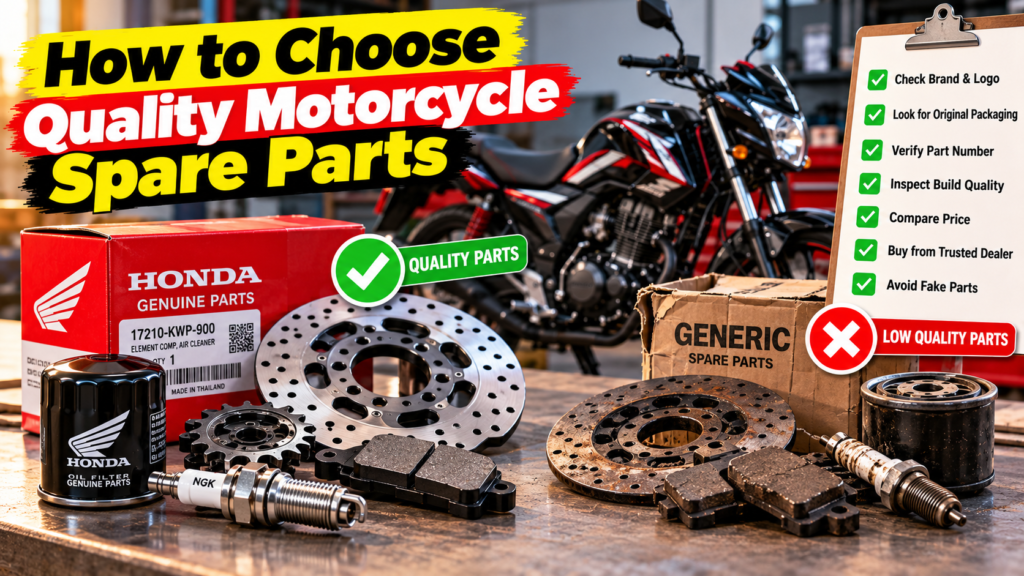
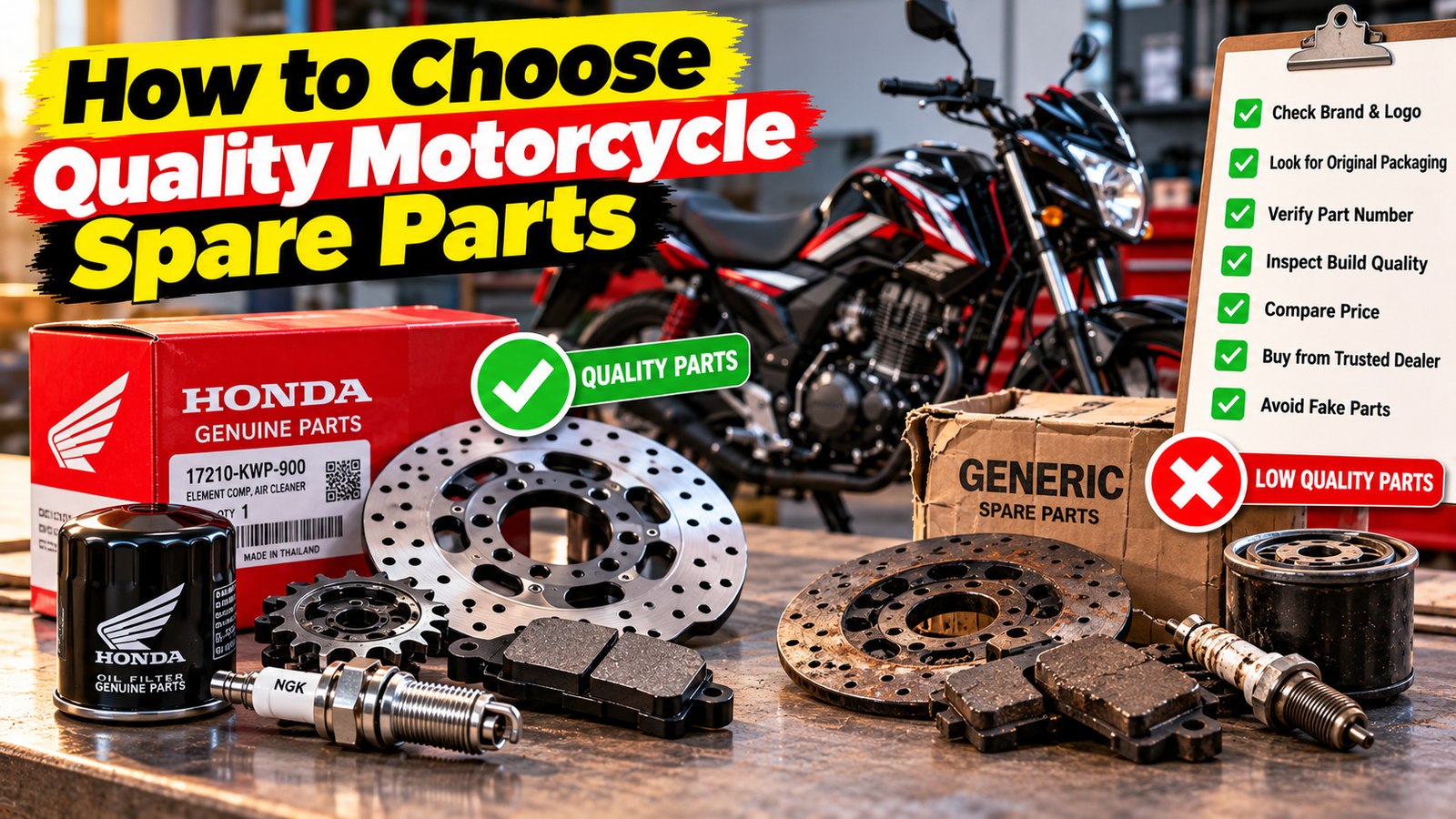
Check whether the packaging identifies the manufacturer, product name, part number, and other relevant details. Compare this information with the manufacturer’s official product information when available.
Look for obvious problems such as spelling mistakes, inconsistent branding, missing identification, damaged seals, or labels that do not match the product.
However, attractive packaging does not guarantee authenticity. Counterfeit products can imitate genuine packaging, while legitimate products can sometimes arrive in packaging that has been damaged during transport.
Do not treat a logo, barcode, QR code, or hologram as complete proof of authenticity unless the manufacturer provides a reliable way to verify it.
For expensive or safety critical parts, buying through an authorized or otherwise verifiable supply channel is generally a better choice than relying on packaging appearance alone.
8. Compare Price and Long Term Value
Price matters when selecting motorcycle spare parts, especially if you use your motorcycle every day. However, comparing only the initial cost can lead to poor purchasing decisions.
A cheaper component may be reasonable if it comes from a reputable manufacturer, meets the correct specifications, and provides suitable durability. On the other hand, a very inexpensive product with unclear manufacturing details may not offer good value.
Consider the expected service life, warranty, compatibility, and possible cost of installation or repeat replacement.
For example, if a low quality chain wears out quickly and damages the sprockets, the total repair cost may be greater than the cost of purchasing a reliable chain and maintaining it correctly.
At the same time, an expensive product is not automatically the best choice. Compare genuine specifications and verified information rather than assuming that a higher price guarantees better performance.
The goal is to find a dependable component at a reasonable price.
9. Read Product Descriptions and Reviews Carefully
Online shopping makes it easier to compare motorcycle spare parts, but it also requires careful checking.
Start by reading the complete product description. Confirm the exact motorcycle model, manufacturing year, dimensions, part number, included accessories, and any installation requirements.
Next, look for reviews that discuss actual use. Comments about correct fitment, product durability, packaging, and customer support can provide more useful information than short reviews that only say the product is good.
Be cautious when many reviews use nearly identical wording or provide little practical detail.
Product photographs can help you compare shapes and connectors, but photographs may be illustrative rather than images of the exact item you will receive. Ask the seller for clarification if important details are missing.
When buying through an online marketplace, also review the return and refund conditions before placing an order.
10. Consider the Warranty and Return Policy
A warranty can provide useful protection when a motorcycle spare part develops a covered fault. However, warranty conditions differ between manufacturers and sellers.
Before purchasing, check how long the warranty lasts, what it covers, and whether proof of purchase is required. Some warranties exclude normal wear, incorrect installation, misuse, or modifications.
Also review the return policy. You may need to exchange a part if it does not fit your motorcycle or if the wrong item is delivered.
Do not assume that a seller will accept a used or installed component for return. Some parts, particularly electrical items and components that show installation marks, may have special conditions.
Keep your receipt, warranty documents, and product packaging where practical. If a mechanic installs the part, retain the service record as well.
Clear warranty information is one sign that a seller has established procedures for handling customer concerns.
11. Ask a Mechanic When You Are Unsure
You do not need to understand every technical detail to buy motorcycle spare parts responsibly. When you are uncertain, an experienced mechanic can help identify the correct component and explain the available options.
A mechanic can inspect the damaged part, check related components, and determine whether replacement is actually necessary. This is useful because similar symptoms can have different causes.
For example, poor acceleration may result from a clutch problem, a fuel delivery issue, or another engine fault. Replacing a random component without diagnosis may waste money.
You can also ask the mechanic whether an original part or a reputable aftermarket alternative is suitable for your motorcycle.
For complex repairs involving brakes, steering, suspension, engine internals, or electrical systems, professional installation is often the safer option.
12. Avoid Common Mistakes When Buying Spare Parts
Motorcycle owners sometimes make avoidable mistakes when selecting replacement components.
One common mistake is buying a part based only on its appearance. Two components may look alike but have different dimensions, fittings, or operating specifications.
Another mistake is choosing the cheapest available product without checking the manufacturer or seller. A low price can be attractive, but unclear product information should encourage caution.
Some buyers also ignore the manufacturing year or variant of their motorcycle. This can lead to fitment problems even when the model name appears correct.
Other mistakes include ignoring warranty conditions, failing to keep receipts, and assuming that every aftermarket product is unsuitable.
A better approach is to identify the required part, verify compatibility, compare dependable options, and ask for help when necessary.
Conclusion
Choosing quality motorcycle spare parts does not have to be complicated. The most important steps are knowing your motorcycle’s exact specifications, checking part numbers, evaluating the manufacturer, and purchasing from a reliable seller.
It is also important to compare original and aftermarket options carefully, especially when replacing components that affect braking, steering, suspension, or engine operation.
In my opinion, a good buying decision balances quality, compatibility, durability, and price. Spending a little more on a dependable part can sometimes prevent repeated replacements, but a higher price alone does not guarantee quality.
Before purchasing any motorcycle spare part, take time to verify the details and ask questions if something is unclear. Regular maintenance, suitable replacement components, and correct installation can help keep your motorcycle reliable for everyday riding.