Introduction
Motorcycle spare parts play an important role in keeping a bike reliable, comfortable, and safe. Whether you use your motorcycle for daily commuting, travelling to work, or taking longer trips, different components eventually need maintenance or replacement. However, choosing the right replacement parts is not always easy because genuine, aftermarket, and counterfeit products can look very similar.
In my opinion, every motorcycle owner should learn how to identify genuine motorcycle spare parts before making a purchase. Buying a component simply because it looks original or has a low price can sometimes lead to unnecessary expenses. A poor quality part may wear out quickly, fit incorrectly, or affect the performance of other components.
The good news is that there are several practical ways to check motorcycle spare parts before buying them. By examining packaging, part numbers, seller reputation, product quality, and official verification options, riders can make more informed decisions.
In this guide, I will explain how to identify genuine motorcycle spare parts, what warning signs to look for, and how to avoid common mistakes when purchasing replacement components.
1. Understand What Genuine Motorcycle Spare Parts Mean
Genuine motorcycle spare parts are original replacement components supplied by the motorcycle manufacturer or its authorized parts network. They are intended for specific motorcycle models and are generally designed to match the manufacturer’s specifications.
For example, if you own a Honda, Yamaha, Suzuki, or another motorcycle brand, you may be able to purchase original replacement parts through an authorized dealer.
However, genuine parts should not be confused with every product described as original quality, OEM quality, or factory standard. These expressions can be used differently by sellers and do not automatically prove that a component is genuine.
Aftermarket parts are produced by independent manufacturers. Some aftermarket companies make reliable products, but they are not necessarily genuine parts supplied under the motorcycle manufacturer’s brand.
Counterfeit parts are products presented as genuine when they are not authentic. These products may copy the packaging, logos, or part numbers of established brands.
Understanding these differences is the first step toward buying the right motorcycle spare parts.
2. Check the Packaging Carefully
Packaging is one of the first things to examine when purchasing motorcycle spare parts.
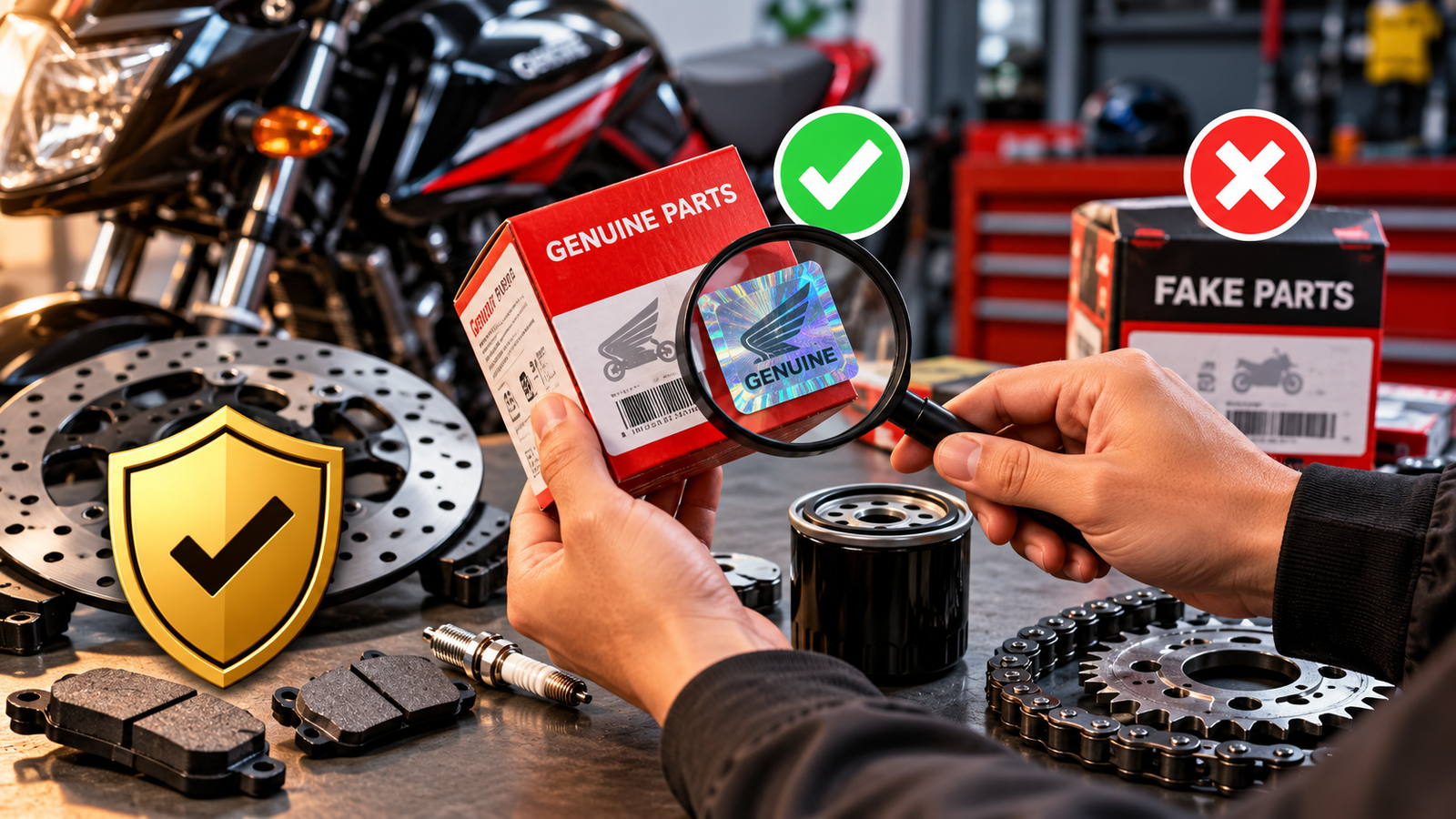
Genuine parts sold through official channels often come in packaging with consistent branding, product information, and identifying details. Depending on the manufacturer and component, the packaging may include a part number, barcode, batch information, or other markings.
Look for clear printing, accurate spelling, and professional packaging. Blurry logos, spelling mistakes, damaged labels, or inconsistent colours can be warning signs.
However, packaging alone cannot confirm authenticity. Counterfeit manufacturers may reproduce packaging that looks almost identical to the original.
Some genuine parts may also arrive in plain packaging or different packaging because of regional distribution arrangements. Therefore, the absence of a particular box design does not automatically mean a part is fake.
The best approach is to compare the packaging with information from the official manufacturer or authorized seller when possible.
3. Verify the Motorcycle Part Number
A part number is one of the most useful details when identifying motorcycle spare parts.
Manufacturers often assign specific numbers to components so that dealers and mechanics can identify the correct item. These numbers can help distinguish between parts designed for different models, years, or engine versions.
Before buying a component, check the part number against the motorcycle manufacturer’s official parts catalogue or ask an authorized dealer to confirm it.
For example, two motorcycles may look almost identical but use different brake components, filters, electrical connectors, or mounting arrangements. A matching appearance does not guarantee compatibility.
Also remember that a correct part number does not prove authenticity by itself. Counterfeit products may copy genuine numbers.
Use the number alongside other checks, including the seller’s reputation, product details, and available verification methods.
4. Buy From Authorized Dealers or Trusted Sellers
The seller you choose can make a significant difference when purchasing genuine motorcycle spare parts.
Authorized motorcycle dealers are often a reliable starting point because they have access to official parts catalogues and manufacturer supply channels. They may also help confirm which components fit your motorcycle.
Established motorcycle spare parts shops can be useful as well, particularly when authorized dealers do not stock a particular item. Look for sellers with a consistent business history, clear contact details, reasonable return policies, and transparent product information.
If you are buying online, check the seller’s identity and read customer feedback carefully. Give more attention to detailed reviews that discuss the actual product, fitment, and customer service.
Be cautious when a seller claims to offer genuine branded parts at an unusually low price without providing a clear explanation.
A low price does not automatically mean a product is counterfeit, but a deal that seems unrealistic deserves additional verification.
5. Examine the Build Quality and Finish
The physical appearance of a motorcycle spare part can provide useful clues about its quality.
Depending on the component, examine the material, finish, dimensions, connectors, markings, and overall construction. A part should appear consistent with the manufacturer’s specifications and product information.
For example, a metal component should not have unexplained cracks, severe rough edges, or obvious manufacturing defects. Electrical connectors should be correctly shaped and positioned, while rubber components should not show unexpected damage or deterioration.
However, manufacturing methods and surface finishes vary between different genuine parts. Not every original component has a perfectly polished appearance, and some genuine parts may contain normal production marks.
For this reason, appearance should be treated as one part of the inspection rather than final proof of authenticity.
If a component looks significantly different from the same part shown in official documentation, ask the seller to explain the difference before purchasing it.
6. Look for Official Authentication Features
Some motorcycle manufacturers use security labels, scratch codes, QR codes, holograms, or other product verification features on selected products.
These features may allow buyers to check a product through an official website, application, or customer service channel.
If the packaging includes a verification code, follow the manufacturer’s official instructions. Avoid relying on unfamiliar websites or scanning codes that lead to suspicious pages.
Not every genuine motorcycle part includes an authentication label. The system may also differ according to the manufacturer, product category, or market.
A copied QR code or hologram is not always reliable proof of authenticity. If the verification result is unclear, contact the manufacturer or an authorized dealer.
The safest method is to use only verification procedures confirmed by the relevant brand.
7. Compare the Price With Other Sellers
Price is another factor that can help identify potentially suspicious motorcycle spare parts.
Genuine replacement components have different prices depending on the brand, availability, shipping costs, and local market. It is therefore useful to compare prices from several reputable sellers before making a purchase.
If one seller offers a branded component at a price far below the normal market range, investigate why.
Possible explanations include a genuine promotion, clearance stock, an older packaging version, or a difference in the product being offered. In other cases, the item may be counterfeit, used, damaged, or incorrectly described.
Ask whether the part is new, genuine, compatible with your motorcycle, and covered by a return policy.
Rather than automatically choosing the cheapest option, consider authenticity, quality, fitment, and long term value.
8. Check the Fit and Compatibility
Even a genuine motorcycle spare part can be unsuitable if it is intended for a different model or version.
Before purchasing, identify your motorcycle’s exact model, year, engine capacity, and relevant variant. Check whether the replacement part matches the original specifications.
This is especially important for components such as brake pads, filters, clutch plates, electrical sensors, chains, sprockets, and engine parts.
Some replacement components may look similar but differ in size, mounting points, electrical connections, or operating specifications.
Do not force a part into position if it does not fit properly. Incorrect installation can damage the component or other motorcycle parts.
If you are uncertain about compatibility, ask an authorized dealer or qualified mechanic to confirm the correct part number before buying.
9. Ask for a Receipt and Warranty Information
A proper purchase record can help if a replacement part turns out to be defective or incorrectly supplied.
Ask the seller for a receipt that identifies the product and records the purchase date. Where applicable, check whether the part includes a manufacturer’s warranty or a seller’s warranty.
Review the warranty conditions carefully. Find out what is covered, how long the coverage lasts, and what documentation is needed to make a claim.
A seller’s warranty does not independently prove that a component is genuine, but transparent documentation can make it easier to resolve problems.
Be cautious if a seller refuses to provide any purchase record or gives unclear answers about the product’s origin.
For expensive components, keep the packaging, receipt, and part number until you are satisfied with the purchase.
10. Be Careful When Buying Motorcycle Parts Online
Online shopping makes it easier to compare motorcycle spare parts, but buyers should pay attention to product descriptions and seller information.
Start by checking whether the listing clearly identifies the manufacturer, part number, compatible motorcycle models, and product condition.
Look carefully at product photographs, but remember that some sellers use generic images that may not represent the exact item being shipped.
Read reviews that discuss authenticity, fitment, delivery, and durability. Repeated complaints about incorrect products, misleading descriptions, or poor quality deserve attention.
Check the return policy before ordering. A reliable seller should explain what happens if the part is incompatible, damaged, or not as described.
When possible, purchase from the manufacturer’s official store or a verified authorized retailer.
11. Common Warning Signs of Counterfeit Motorcycle Parts
There is no single sign that proves a motorcycle part is counterfeit, but several warning signs deserve attention.
These include:
- Packaging with spelling mistakes or inconsistent branding.
- A part number that does not match official product information.
- An unusually low price without a reasonable explanation.
- A seller who cannot explain the product’s source.
- Poor construction or obvious manufacturing defects.
- Missing documentation where it would normally be expected.
- Suspicious authentication codes or verification results.
- Product descriptions that make unsupported claims about authenticity.
One warning sign may have an innocent explanation, so avoid making a final decision based on a single detail.
If several warning signs appear together, do not install the part until its origin and suitability have been checked.
12. Why Genuine Motorcycle Spare Parts Matter
Using the correct replacement components helps maintain the motorcycle’s intended design and operating characteristics.
Parts such as brake components, steering assemblies, suspension components, and engine internals have important functions. Incorrect specifications or poor manufacturing quality can affect reliability and, in some cases, safety.
Genuine parts are often a practical choice when the owner wants a replacement that follows the manufacturer’s specifications. However, genuine status alone does not eliminate the need to inspect the part, confirm compatibility, and install it correctly.
High quality aftermarket parts can also be suitable when they come from reputable manufacturers and meet the motorcycle’s requirements.
The main goal should be to select a reliable, compatible component from a trustworthy source rather than relying on branding or price alone.
Conclusion
Learning how to identify genuine motorcycle spare parts can help motorcycle owners avoid counterfeit products, unsuitable components, and unnecessary expenses.
In my opinion, the best approach is to check several details before buying. Verify the part number, examine the packaging and build quality, compare prices, confirm compatibility, and purchase from a trusted seller. If the manufacturer offers an official authentication system, use it to check the product where applicable.
It is also important to remember that genuine parts, aftermarket parts, and counterfeit products are different categories. A reputable aftermarket component may be a suitable choice, while a counterfeit item falsely claims to be genuine.
By taking a little extra time before making a purchase, riders can make better decisions and maintain their motorcycles with greater confidence.