Introduction
A motorcycle carburetor is an important component in many petrol powered motorcycles. Its main job is to mix air and fuel in the correct proportion so the engine can produce power. Although many modern motorcycles use fuel injection systems, carburetors are still found in older motorcycles, small bikes, and some off road models.
In my opinion, understanding motorcycle carburetor parts is useful for every rider who wants to learn more about motorcycle maintenance. When a motorcycle develops starting problems, rough idling, poor fuel economy, or weak acceleration, the carburetor may be one of the components that needs inspection.
A carburetor contains several small parts that work together to control fuel delivery and airflow. Each part has a specific function, and a problem with even one component can affect engine performance.
In this article, I will explain the main motorcycle carburetor parts and their functions in simple language. I will also discuss common carburetor problems, maintenance tips, and the importance of choosing the correct replacement parts.
What Is a Motorcycle Carburetor?
A motorcycle carburetor is a mechanical device that mixes petrol with incoming air before the mixture enters the engine. The engine needs the correct air and fuel mixture to support combustion and produce power.
When the engine operates, it draws air through the intake system. As air moves through the carburetor, the pressure difference helps draw fuel through small openings called jets. The carburetor then mixes the fuel with the incoming air and delivers the mixture toward the engine.
The process depends on the carburetor design, engine speed, throttle position, and operating conditions.
Unlike an electronic fuel injection system, a traditional carburetor generally controls fuel delivery through mechanical components, calibrated passages, and pressure differences rather than electronically controlled injectors.
A motorcycle carburetor is relatively simple in principle, but its small passages and precise adjustments require proper care.
1. Carburetor Body
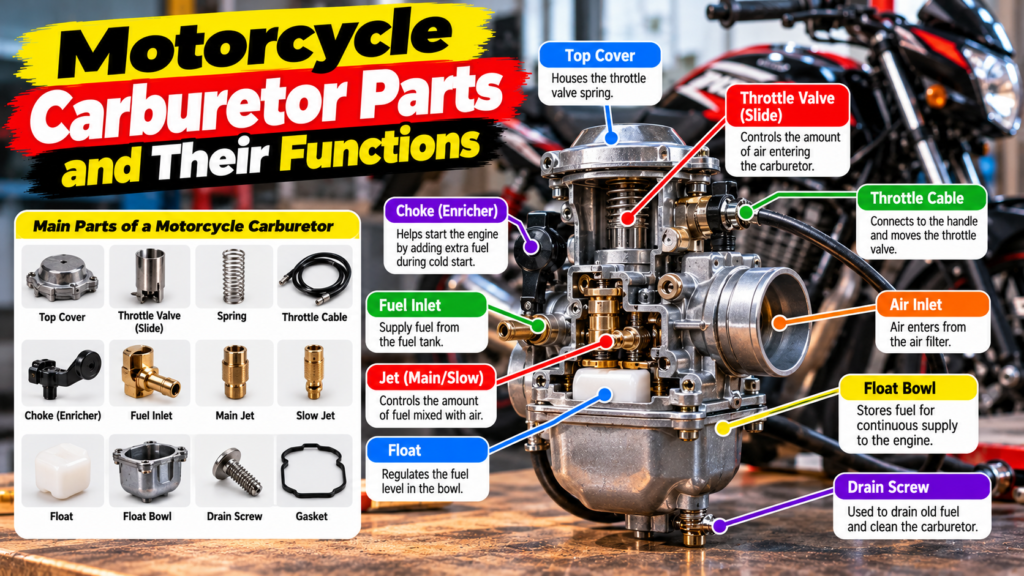
The carburetor body is the main structure that holds and supports most of the carburetor components. It contains the air passage, fuel passages, mounting points, and openings for different valves and jets.
The body is commonly made from an aluminum alloy because it is lightweight and suitable for the operating environment.
Air enters the carburetor through the intake side, passes through its internal passage, and mixes with fuel before moving toward the engine.
The carburetor body must remain clean and free from damage. Dirt, corrosion, or blocked internal passages can interfere with airflow and fuel delivery.
When replacing a carburetor, it is important to select a model that matches the motorcycle’s engine and intake system. A carburetor that looks similar may still have different dimensions or calibration requirements.
2. Float Bowl
The float bowl is a small chamber that stores a limited supply of petrol inside the carburetor. It is commonly located at the bottom of the carburetor.
Its main function is to keep fuel available for the jets while the engine is running.
As the engine consumes fuel, the level inside the bowl drops. The float mechanism responds by allowing more fuel to enter. When the correct level is restored, the fuel supply is restricted.
If the float bowl becomes dirty, water or debris may interfere with normal fuel delivery. Deposits can also develop when petrol remains in the carburetor for a long period.
A damaged bowl gasket may cause fuel leakage. If petrol leaks from the bottom of the carburetor, the float bowl, drain screw, or related seals may need inspection.
Keeping the float bowl clean and correctly sealed helps maintain reliable carburetor operation.
3. Float
The float is a lightweight component inside the float bowl. It rises and falls according to the amount of fuel present in the chamber.
Its main purpose is to help maintain the correct fuel level.
When the fuel level drops, the float moves downward and allows the inlet valve to open. As the bowl fills, the float rises and helps close the valve.
If the float becomes damaged, sticks, or is adjusted incorrectly, the fuel level may become too high or too low.
A high fuel level can cause an excessively rich mixture, flooding, or fuel leakage. A low fuel level may restrict fuel delivery and cause the engine to hesitate or lose power.
The float must move freely and operate according to the manufacturer’s specifications. Incorrect adjustments can create performance problems, so repairs should be performed carefully.
4. Float Needle Valve
The float needle valve controls the entry of fuel into the float bowl. It works together with the float to regulate the fuel level.
When the float moves downward, the needle valve opens and allows petrol to enter. When the float rises to the specified level, the valve closes or restricts the fuel supply.
This mechanism prevents the bowl from continuously filling with fuel.
A worn needle valve, damaged sealing surface, or stuck float can cause fuel overflow. In some cases, fuel may leak through the carburetor or enter areas where it should not accumulate.
If a motorcycle repeatedly floods or leaks petrol while parked, the float needle valve and its seat should be inspected.
Replacing a worn valve with a suitable part can help restore proper fuel control. The float level should also be checked because replacing the valve alone may not solve every problem.
5. Main Jet
The main jet is a small, precisely calibrated component that controls fuel delivery through the main fuel circuit.
It becomes particularly important as the throttle opens and the engine requires more fuel. Its exact influence depends on the carburetor design and the engine’s operating conditions.
The main jet contains a carefully sized opening. Fuel passes through this opening before entering the carburetor’s main metering system.
If the main jet becomes blocked by dirt or deposits, the engine may struggle to produce power under acceleration or higher loads.
An incorrectly sized main jet can also affect the air and fuel mixture. A jet that supplies too much fuel may create a rich mixture, while one that supplies too little may contribute to a lean mixture under relevant operating conditions.
The correct main jet depends on the motorcycle model and its engine setup. Riders should avoid changing jet sizes without understanding the manufacturer’s specifications and the symptoms being investigated.
6. Pilot Jet
The pilot jet, also called the slow jet or idle jet, supplies fuel when the engine is idling and operating at small throttle openings.
At low engine speeds, the main fuel circuit may not provide the required mixture on its own. The pilot circuit helps supply fuel during these conditions.
Because the pilot jet contains a very small opening, it can become blocked by dirt or deposits from old petrol.
A blocked pilot jet may cause difficult starting, rough idling, or an engine that stalls when the throttle is closed.
Sometimes, a motorcycle runs reasonably well at higher speeds but struggles to remain running at idle. In such cases, the pilot circuit may require inspection.
Cleaning a blocked pilot jet with an approved carburetor cleaning method may restore fuel flow. Avoid using hard metal objects that can enlarge or damage the precisely calibrated opening.
7. Needle Jet and Jet Needle
The needle jet and jet needle work together to regulate fuel delivery as the throttle opens through a range of positions.
The needle jet provides a passage for fuel, while the tapered jet needle moves in relation to that passage.
As the throttle slide rises, the needle moves and changes the available opening for fuel flow. This helps the carburetor adjust fuel delivery as airflow increases.
The exact operation varies between carburetor designs, but these components are particularly important for smooth response during moderate acceleration.
Wear, incorrect assembly, or unsuitable adjustments can affect fuel delivery and cause hesitation or uneven performance.
When servicing these components, use the correct parts and follow the manufacturer’s instructions. The needle position should not be changed randomly because incorrect settings may affect engine performance and fuel consumption.
8. Venturi
The venturi is a narrowed section of the carburetor’s air passage. Its shape increases air velocity and creates a pressure drop that helps draw fuel into the moving air.
This principle is central to how a conventional carburetor works.
As the engine draws air through the venturi, the pressure difference helps move fuel from the float bowl through the relevant jets and discharge passages.
The fuel then mixes with the airflow before entering the engine.
The venturi must have the correct size and design for the motorcycle. A larger or smaller carburetor does not automatically improve performance because airflow speed, fuel delivery, and engine requirements must work together.
For most everyday riders, maintaining the original carburetor specification is a practical way to support reliable operation.
9. Throttle Valve or Throttle Slide
The throttle valve controls how much air passes through the carburetor and therefore helps regulate engine power.
On many motorcycle carburetors, the throttle uses a cylindrical slide that moves upward or downward. Other designs use a butterfly valve that rotates to control airflow.
When the rider twists the throttle grip, a cable or another mechanism moves the valve.
Opening the throttle allows more air to enter. The carburetor’s metering circuits respond to changing airflow and pressure conditions to provide the required fuel.
If the throttle slide sticks, the motorcycle may respond poorly or fail to return to idle correctly.
A damaged throttle cable, incorrect cable adjustment, or dirty internal surfaces can contribute to this problem.
The throttle should move smoothly and return to its resting position when released. If it sticks, do not continue riding until the cause has been identified and corrected.
10. Choke or Enrichment System
The choke or enrichment system helps a cold engine start more easily.
When an engine is cold, the fuel does not vaporize as readily as it does at normal operating temperature. A richer mixture may therefore be required for starting.
Some carburetors use a choke plate that restricts incoming air. Other designs use an enrichment circuit that supplies additional fuel through a separate passage.
The operating method depends on the carburetor design.
Once the engine warms up, the choke should be returned to its normal running position according to the manufacturer’s instructions.
Leaving a manual choke engaged for too long can result in excessive fuel consumption, rough running, or spark plug fouling.
If the motorcycle struggles to start when cold even when the enrichment system is used correctly, the carburetor, ignition system, or another engine component may require inspection.
11. Air and Fuel Mixture Screw
The mixture screw helps adjust the mixture supplied by the carburetor’s idle or low speed circuit.
Depending on the carburetor design, it may control fuel flow or air flow. Its location and function determine which type it is.
An incorrectly adjusted mixture screw can contribute to rough idling, hesitation, or difficulty maintaining a stable idle.
The correct adjustment varies according to the motorcycle model and carburetor specifications.
Before making changes, consult the service manual. Some screws have factory settings, and certain models use special arrangements that should not be adjusted without proper knowledge.
Randomly turning the mixture screw may make the engine run worse rather than improve it.
If the motorcycle continues to idle poorly after basic maintenance, a qualified mechanic can inspect the idle circuit and adjust the mixture correctly.
12. Throttle Cable and Linkage
The throttle cable connects the rider’s throttle grip to the carburetor’s throttle mechanism.
When the rider twists the grip, the cable moves the slide or another valve to change airflow and engine response.
The cable should move smoothly without excessive resistance. It also needs the correct amount of free play, as specified by the motorcycle manufacturer.
A damaged, frayed, poorly routed, or incorrectly adjusted cable can cause throttle response problems.
If the cable becomes stuck, the throttle may not close properly. This can create a serious safety risk.
Inspect the cable during routine maintenance and replace it if damaged. After any adjustment, check that the throttle returns freely with the handlebars turned in both directions.
13. Carburetor Gaskets and Seals
Gaskets and seals help prevent fuel or air leaks around the carburetor’s joints and connections.
They may be found around the float bowl, fuel inlet, adjustment components, and mounting areas.
Over time, some seals can become hardened, damaged, or worn. A leaking float bowl gasket may allow petrol to escape, while a leak on the engine side of the carburetor may allow unwanted air to enter.
An intake air leak can disturb the mixture and contribute to unstable idling or poor engine operation.
If a gasket is damaged, replacing it with the correct part is generally better than applying an unsuitable sealant.
Fuel leaks should always be taken seriously. Switch off the motorcycle, keep it away from flames and sparks, and arrange repairs before riding again.
Common Motorcycle Carburetor Problems
Understanding carburetor parts makes it easier to recognize common problems.
A blocked pilot jet may cause rough idling or stalling. A dirty main jet can affect fuel delivery when the engine needs more power. A faulty float needle valve may allow fuel to overflow, while an incorrectly adjusted float can cause an unsuitable fuel level.
A sticking throttle slide or damaged cable can affect throttle response. Worn gaskets can also create leaks or allow unwanted air into the intake system.
However, not every engine problem comes from the carburetor. A weak battery, worn spark plug, blocked air filter, or poor fuel supply may produce similar symptoms.
For this reason, it is important to inspect the motorcycle systematically instead of replacing carburetor parts without confirming the cause.
Tips for Maintaining Motorcycle Carburetor Parts
Regular maintenance helps keep carburetor components working properly.
First, use clean petrol from a reliable source and avoid allowing dirt to enter the fuel tank. Contaminated fuel can block small passages and interfere with fuel delivery.
Second, follow the motorcycle manufacturer’s recommendations for long term storage. Petrol left in a carburetor for extended periods may deteriorate and leave deposits.
Third, inspect the fuel lines, gaskets, and visible connections for leaks or damage.
If cleaning becomes necessary, use products suitable for carburetors and follow the correct procedure. Small jets and internal passages require careful handling because damage can affect fuel metering.
Avoid changing jet sizes or adjustment settings without a clear reason. Incorrect modifications may increase fuel consumption or affect engine operation.
If the carburetor requires complete disassembly, float adjustment, or detailed tuning, professional servicing may be the better option for beginners.
Conclusion
Motorcycle carburetor parts work together to control airflow, regulate fuel delivery, and provide the mixture required for engine operation. Components such as the float bowl, float, needle valve, main jet, pilot jet, venturi, throttle valve, and choke each have an important function.
From my point of view, understanding these parts helps motorcycle owners recognize common problems and make better maintenance decisions. A carburetor does not always need replacement when a motorcycle develops performance issues. Sometimes, careful cleaning, correct adjustment, or replacing a worn component is enough to restore proper operation.
The most important thing is to use compatible parts, keep the fuel system clean, and avoid unnecessary adjustments. Regular inspection and timely repairs can help maintain reliable engine performance and reduce avoidable repair expenses.
By learning how motorcycle carburetor parts function, riders can better understand their bikes and know when it is appropriate to seek professional assistance.